

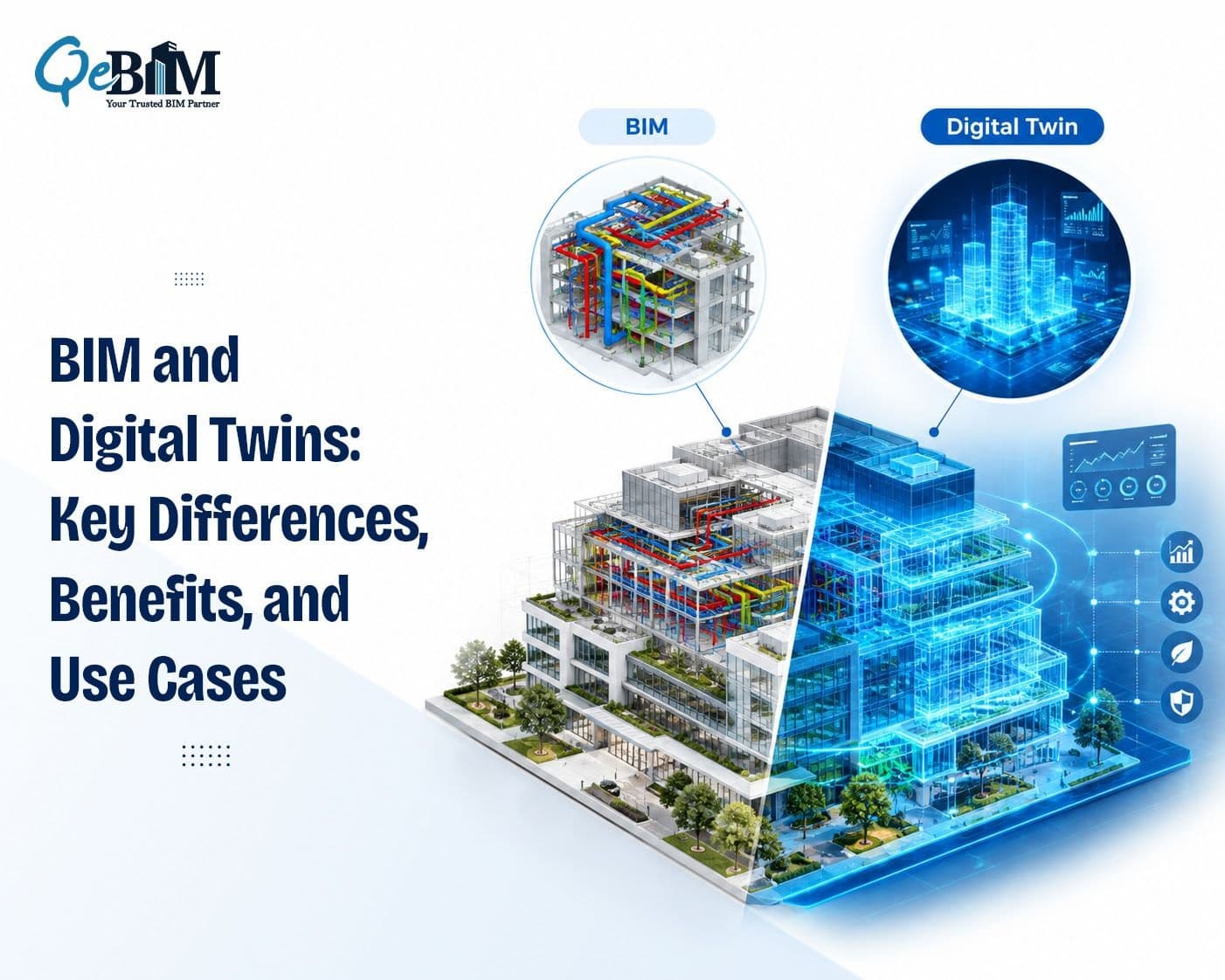
BIM and Digital Twins: Key Differences, Benefits, and Use Cases
BIM and Digital Twins are frequently considered together as both create digital representations of physical assets and their associated information. However, they serve different purposes, operate at different stages of the asset lifecycle and rely on different levels of data integration.
While BIM primarily focuses on creating and managing structured information about a building or infrastructure asset, a Digital Twin goes further by connecting a digital representation to the physical asset through continuously updated data.
Understanding this distinction helps architects, engineers, contractors and facility managers determine which technology is appropriate for a project.
What Is BIM?
BIM is a collaborative digital process used to create, manage and exchange structured information throughout the design and construction lifecycle. A BIM model can contain geometry, specifications, material information, spatial relationships, quantities and other project data.
Unlike conventional 2D drawings, BIM develops an intelligent, interconnected model where individual building elements are linked and coordinated. For example, a wall can contain information about its dimensions, material, fire rating, manufacturer and relationship to doors, windows, structural elements and MEP systems.
BIM is particularly valuable during:
Conceptual and detailed design
Multidisciplinary coordination
Clash detection
Construction documentation
Quantity take-offs
Shop drawing development
Construction planning
As-built documentation
Handover and facility information management
A properly developed BIM model therefore becomes a reliable source of project information before and during construction.
What Is a Digital Twin?
A Digital Twin is a dynamic digital replica of a physical asset, system, or environment that continuously reflects real-world conditions through connected data.
The key difference is connectivity.
A conventional BIM model may describe how a building was designed or constructed. A Digital Twin can incorporate information about how that building is actually performing.
Sensors, IoT devices, building management systems, operational databases, maintenance platforms and other data sources can continuously feed information into the digital environment.
For example, a Digital Twin of a commercial building could receive real-time information about:
Temperature
Humidity
Energy consumption
Equipment status
Occupancy
Air quality
HVAC performance
Maintenance conditions
This allows facility teams to move from simply documenting an asset to actively monitoring and optimizing it.
BIM vs Digital Twin: The Core Difference
The simplest way to understand the relationship is:
BIM describes and manages asset information. A Digital Twin connects that information to real-world operational data.
BIM is generally more focused on design, construction, coordination, and structured asset information, whereas Digital Twins are particularly valuable during operations, monitoring, simulation, optimization and predictive maintenance.
Importantly, BIM and Digital Twins are not competing technologies.BIM can serve as a reliable information foundation for developing a Digital Twin.
How BIM Can Become the Foundation for a Digital Twin?
Developing an effective Digital Twin depends on having accurate and reliable information about the physical asset.
A coordinated BIM model can provide the geometric structure and asset information needed to represent a building digitally. Once the building becomes operational, additional data sources can be connected to relevant model elements.
For example, an HVAC unit represented within a BIM model could later be associated with:
Equipment identification
Manufacturer information
Installation date
Maintenance history
Sensor readings
Operating conditions
Replacement schedules
The BIM model provides the digital structure, while operational systems provide the live intelligence.
This integration can create a more comprehensive asset information environment for facility management and decision-making.
When Do You Need BIM?
BIM is generally the appropriate starting point when the primary objective involves designing, coordinating, documenting or constructing an asset.
You may need BIM when:
1. Multiple disciplines must coordinate
Architectural, structural, and MEP systems can be combined within a federated model to detect spatial clashes and coordination issues before construction begins.
2. Construction accuracy is critical
BIM enables teams to develop coordinated construction information and reduce ambiguity between design intent and site execution.
3. Asset information must be structured
Owners can establish consistent information requirements for building elements, equipment, spaces and systems.
4. Existing buildings need digital documentation
Laser scanning and point-cloud data can be converted into accurate BIM models for renovation, retrofit, maintenance or future development.
For these applications, working with an experienced BIM Services Provider can help establish appropriate modeling standards, levels of development, information requirements and deliverables.
When Do You Need a Digital Twin?
A Digital Twin becomes more valuable when the project moves beyond documentation toward continuous operational intelligence.
Consider a Digital Twin when you need to:
Track building performance in real time
Improve energy efficiency and reduce consumption
Track equipment conditions
Predict maintenance requirements
Analyze occupancy patterns
Simulate operational scenarios
Improve asset lifecycle management
Support data-driven facility decisions
For example, a hospital, airport, manufacturing facility or large commercial building may contain thousands of interconnected systems. A Digital Twin can help facility teams understand how those systems behave collectively rather than simply viewing their static documentation.
Where Revit Fits Into the BIM-to-Digital-Twin Workflow?
Revit is widely used for developing information-rich BIM models across architectural, structural, and MEP disciplines. A well-structured Revit model can serve as an important source of geometry and asset information when developing a broader digital representation.
However, a Revit model by itself is not automatically a Digital Twin.
The transformation requires additional data integration, connectivity, operational information, and appropriate technology infrastructure. Therefore, Revit BIM Services can form an important part of the workflow, but the final Digital Twin ecosystem may also involve IoT platforms, sensors, APIs, cloud databases, analytics tools and facility management systems.
BIM or Digital Twin: Which Tool Should You Choose?
The decision should totally be made on the project's objective and lifecycle stage.
If you are designing or constructing a building, BIM should generally be the priority.
If you are operating an existing asset and need continuous data-driven insights, a Digital Twin may provide greater value.
For many complex projects, the most effective strategy is not choosing one over the other. Instead, organizations can establish a reliable BIM model first and progressively connect it with operational data to develop a Digital Twin.
Conclusion
BIM and Digital Twins represent different stages of digital transformation in the AEC industry. BIM creates a structured digital representation that supports design, coordination, construction, and information management. Digital Twins extend digital asset information by integrating it with real-time operational data from the physical asset.
The future lies increasingly in combining both approaches. A coordinated BIM model can provide the digital foundation, while real-time data, IoT connectivity, analytics, and automation can transform that foundation into an intelligent operational environment.
For organizations planning long-term digital asset management, the question is therefore not simply “BIM or Digital Twin?” but rather “How can BIM become the foundation for a smarter Digital Twin?”