

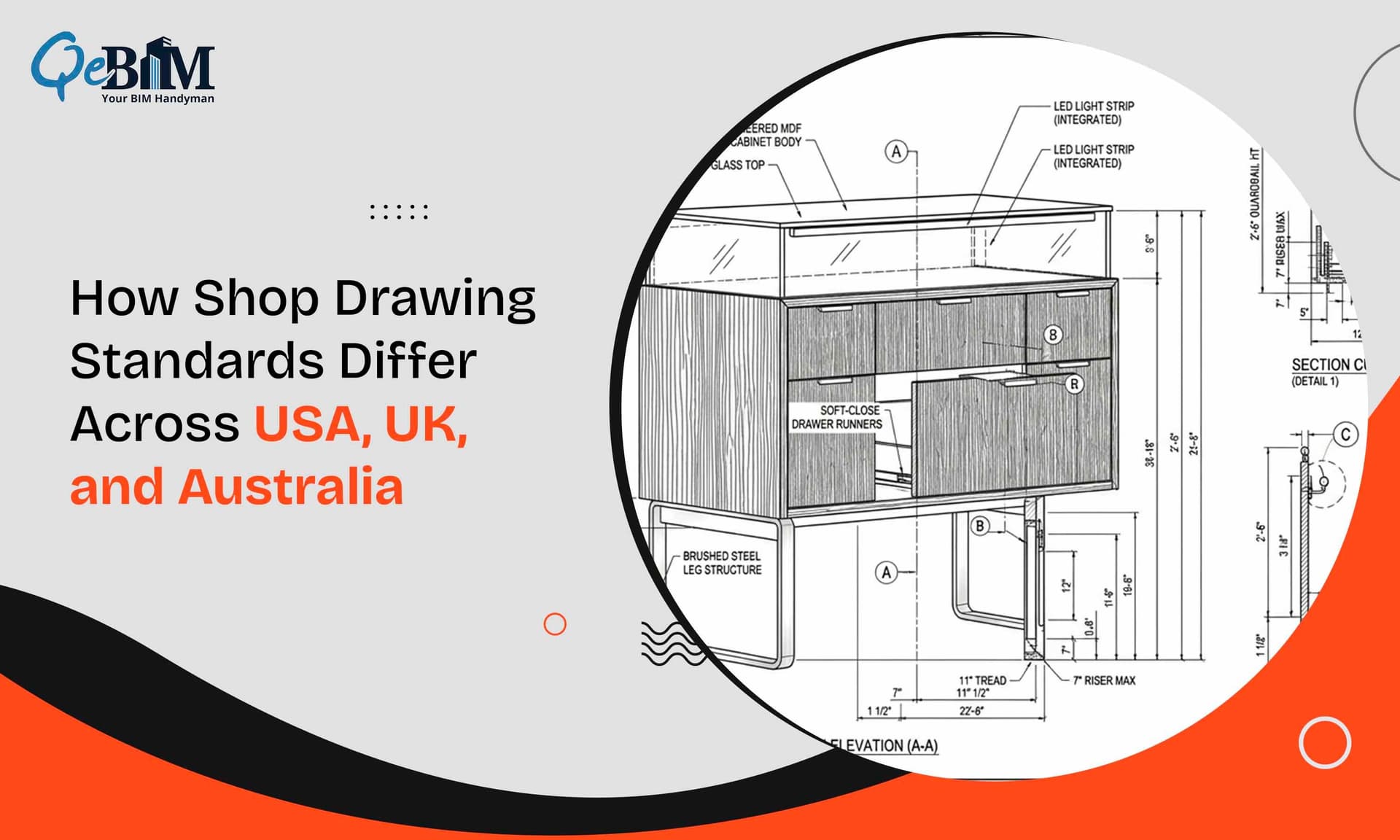
How Shop Drawing Standards Differ Across USA, UK, and Australia
Bold
Introduction
In today’s globalized construction environment, projects frequently span multiple geographies, stakeholders and regulatory frameworks. One of the most crucial yet frequently overlooked aspects of project execution is the variation in shop drawing standards across regions.
Shop drawings serves as the operational bridge between the conceptual design and physical construction. They define how the components are fabricated, assembled and installed with precision thus ensuring constructability and compliance.
However, the standards governing these drawings vary significantly between the USA, UK and Australia, influencing the project workflows, approval cycles and risk management.
This blog explores these regional differences in depth and highlights what the global AEC firms must consider when delivering Shop Drawing Services and Fabrication Drawing Services across international markets.
Understanding Shop Drawings: A Global Baseline
Across all three regions, shop drawings share a common purpose:
Translate design drawings into fabrication-ready documentation
Provide the detailed dimensions, materials, tolerances and installation methods
Ensure coordination between all the trades (structural, MEP, façade, etc.)
Act as a contractual and approval document before the fabrication begins
They are typically produced by subcontractors, fabricators or suppliers and reviewed by architects and engineers prior to the execution.
Despite this shared foundation, regional standards defines how detailed, formatted and regulated these drawings must be.
Shop Drawing Standards in the USA
1. Code Framework & Governing Bodies
In the United States, shop drawings are heavily influenced by:
AIA (American Institute of Architects) contract documents
CSI (Construction Specifications Institute) formats
ASTM, AWS and other trade-specific standards
Federal Acquisition Regulations (FAR) for government projects
2. Key Characteristics
a. Specification-Driven Approach
US shop drawings are tightly linked to the project specifications. Every detail must align with:
Material standards (ASTM)
Welding codes (AWS)
Installation guidelines
b. Submittal-Centric Workflow
Shop drawings are submitted as part of a formal submittal process
Reviewed for compliance—not redesign
Approval status categories: Approved / Approved as Noted / Revise & Resubmit
c. High Emphasis on Liability & Documentation
Clear delineation of responsibility between the contractor and designer
Deviations must be explicitly highlighted
3. Technical Depth
US drawings often includes:
Fabrication details (bolt patterns, weld types)
Manufacturer-specific data
Installation sequencing
Coordination with other systems
Insight: The US system prioritizes risk mitigation and contractual clarity thereby making documentation extremely detailed and legally structured.
Shop Drawing Standards in the UK
1. Code Framework & Compliance
UK shop drawings operate within a structured regulatory ecosystem:
British Standards (BS) and Eurocodes
ISO standards (especially ISO 19650 for BIM workflows)
UK Building Regulations (Part B – Fire Safety, Part K – Safety, etc.)
2. Key Characteristics
a. Millimetre Precision & Standardization
All dimensions typically in millimetres
Strict adherence to tolerance specifications
Material grades clearly defined (e.g., structural steel standards)
b. BIM & CDE Integration
Drawings are managed within a Common Data Environment (CDE)
Naming conventions follow BS 1192 / ISO 19650
Strong alignment with the BIM Level 2 and beyond
c. Compliance-Focused Documentation
Shop drawings must demonstrate the compliance with the building regulations
Fire safety, accessibility and structural integrity are explicitly addressed
3. Technical Content Requirements
A complete UK shop drawing includes:
Plans, sections and elevations views
Material specifications and tolerances
Fixing details and annotations
Coordination notes across disciplines
Insight: The UK system emphasizes the standardization, digital workflows and regulatory compliance thereby making it highly structured and BIM-centric.
Shop Drawing Standards in Australia
1. Code Framework
Australia follows a hybrid approach combining:
Australian Standards (AS)
ISO standards
National Construction Code (NCC)
Shop drawings must align with both the local compliance requirements as well as the international best practices.
2. Key Characteristics
a. Performance-Based Compliance
Focus on meeting performance requirements rather than prescriptive rules
Flexibility in detailing, provided compliance is demonstrated
b. Trade-Specific Detailing
Higher detail required for the systems like HVAC, façade and fire protection
Complexity-driven detailing approach
c. Practical Constructability Focus
Strong emphasis on buildability
Drawings must reflect the real-world site conditions and constraints
3. Documentation Requirements
Material and installation specifications
Coordination with the site conditions
Compliance with safety and authority requirements
Integration with fabrication and installation workflows
Insight: Australia balances flexibility with compliance, focusing heavily on constructability and real-world execution.
Key Differences: USA vs UK vs Australia
Challenges in Multi-Regional Projects
Working across these regions introduces several complexities:
1. Standard Misalignment
Differences in codes and detailing expectations can lead to reworks and approval delays.
2. BIM vs Traditional Workflows
UK projects demansd BIM-integrated documentation, while US projects may still rely on the traditional submittals.
3. Units and Measurement Systems
Conversion errors between the imperial and metric systems can impact the fabrication accuracy.
4. Approval Timelines
US: Longer due to formal submittal cycles
UK: Faster with digital workflows
Australia: Variable depending on project complexity
Best Practices for Global AEC Firms
To successfully deliver across regions:
1. Local Code Expertise
Ensure that the teams understand the region-specific standards (AIA vs BS vs AS).
2. Standardized Templates with Localization
Creates adaptable templates that aligns with the regional requirements.
3. BIM Integration
Adopt ISO 19650 workflows to ensure the compatibility across UK and global markets.
4. Cross-Disciplinary Coordination
Improves coordination between the architectural, structural and MEP systems early.
5. QA/QC Frameworks
Implement rigorous quality checks to avoid compliance issues and reworks.
Conclusion
While shop drawings universally serves as the backbone of the fabrication and construction accuracy, their standards vary significantly across the USA, UK and Australia.
The USA prioritizes contractual clarity and risk management
The UK focuses on standardized, BIM-driven compliance
Australia emphasizes on constructability and performance-based outcomes
For global AEC firms, understanding these nuances is not optional—it is essential for delivering efficient, compliant and high-quality projects.
As the projects becomes increasingly international, the ability to adapt the shop drawing workflows to regional standards will define the project success, reduce reworks and also enhance the collaboration across the entire construction lifecycle