

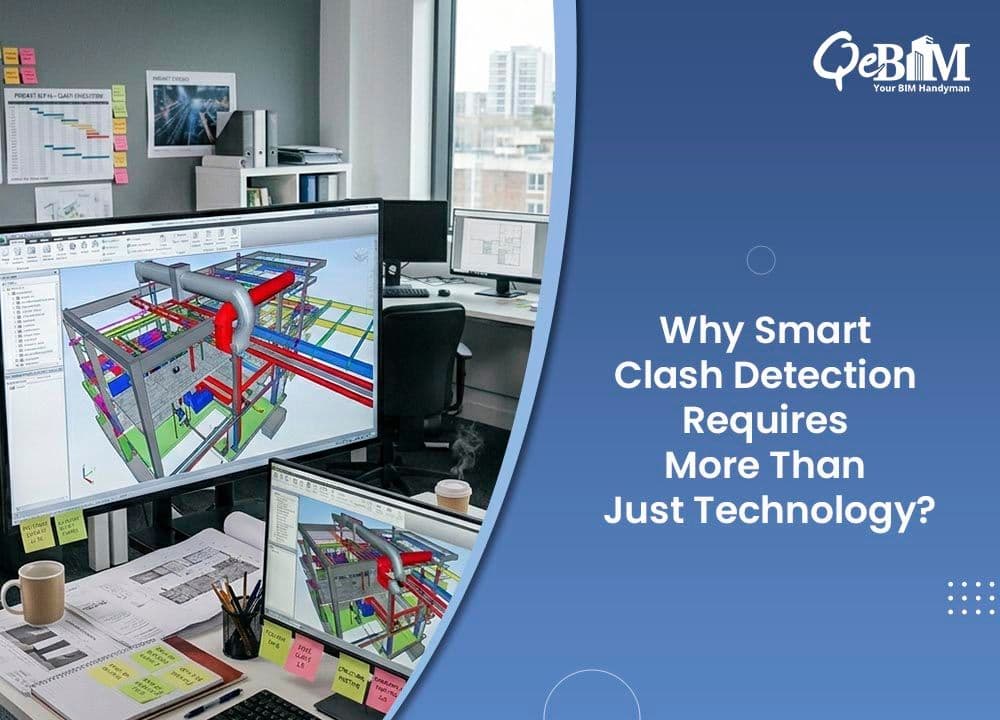
Why Smart Clash Detection Requires More Than Just Technology?
Introduction
In today’s fast-paced construction ecosystem, coordination failures remains one of the leading causes of cost overruns and project delays. While advanced tools have made clash detection more accessible, relying solely on the automation is a critical mistake.
Clash detection is not just about identifying geometric conflicts—it is about ensuring seamless collaboration, constructability and project efficiency. Leading firms offering Clash Detection Services understands that true value lies in combining technology with the process-driven strategies and human expertise.
Understanding Clash Detection Beyond Automation
Clash detection, at its core, involves identifying the conflicts between the different building systems, i.e. structural, architectural and MEP—within a digital model. Tools like Navisworks or Revit can automatically flag clashes, but they cannot:
Prioritize issues based on real-world impact
Understand construction sequencing
Differentiate between critical and negligible clashes
Align coordination with project goals
This is where strategy and experience comes into play.
Why Automation Alone Falls Short?
1. High Volume of False Positives
Automated tools often generates thousands of clashes, many of which are irrelevant (e.g., minor overlaps or intentional design intersections). Without proper filtering, teams waste time addressing non-critical issues.
2. Lack of Contextual Intelligence
Software cannot interpret the site constraints, installation tolerances or trade-specific workflows. For example, a clash between a duct and beam may be technically resolvable on-site but flagged as critical by the system.
3. Coordination Gaps
Automation does not replace the communication. Without the structured coordination meetings, clash reports remains unresolved or misunderstood.
Clash Detection Best Practices
1. Define Clear Clash Detection Rules
Before running any clash test, establish:
Tolerance levels (e.g., 10mm vs 50mm)
Hard clashes vs soft clashes (clearance issues)
Trade-specific priorities
This ensures meaningful and actionable outputs rather than just the cluttered reports.
2. Categorize and Prioritize Clashes
Not all clashes are equal. A mature workflow includes:
Critical clashes: Impacts structural integrity or system functionality
Moderate clashes: Affects installation sequence
Low-priority clashes: Minor or adjustable on-site
Studies suggest that prioritization can reduce the coordination time by up to 30–40%.
3. Integrate Clash Detection with Construction Sequencing
Clash detection should align with:
Project timelines
Installation phases
Site logistics
For example, resolving clashes for early-stage systems (like structural elements) should take precedence over finishing components.
4. Conduct Regular Coordination Meetings
Weekly or bi-weekly coordination meetings are essential to:
Review clash reports
Assign responsibilities
Track resolution progress
This transforms clash detection from a static report into a dynamic decision-making process.
5. Maintain a Centralized Common Data Environment (CDE)
A centralized platform ensures:
Real-time access to updated models
Version control
Improved collaboration across stakeholders
This is a key strength of any professional BIM Services Provider, ensuring transparency and consistency.
6. Focus on Constructability, Not Just Geometry
A clash-free model does not guarantee a buildable project. Teams must evaluate:
Accessibility for installation
Maintenance clearances
Safety considerations
For example, even if systems don’t clash, insufficient access space can lead to rework during the construction.
7. Assign Ownership and Accountability
Each clash should have:
A responsible stakeholder
A defined resolution timeline
A tracking mechanism
Clear ownership accelerates the resolution and avoids delays.
8. Use Standardized Naming and Documentation
Consistent naming conventions and documentation helps to:
Avoid confusion across teams
Streamline reporting
Enable better tracking and analytics
Real-World Impact of Effective Clash Detection
Projects that implements the structured clash detection workflows experience:
Up to 60% reduction in rework costs
Significant improvement in project timelines (15–25%)
Enhanced collaboration between stakeholders
For instance, large-scale infrastructure and commercial projects using advanced BIM coordination have reported millions in cost savings by resolving clashes during the design phase rather than on-site.
The Role of Expertise in Clash Detection
While software identifies clashes, it takes experienced professionals to:
Interpret results
Suggests practical solutions
Aligns coordination with the project goals
This is why leading construction firms partner with the specialized teams rather than relying solely on just in-house automation tools.
Conclusion
Clash detection is far more than a checkbox in the BIM workflow—it is a strategic process that directly impacts the project success. Automation provides the foundation, but true efficiency comes from combining the technology with expertise, structured workflows and proactive collaboration.
By adopting these best practices, organizations can move beyond the reactive problem-solving and towards the predictive, efficient as well as error-free project delivery.