
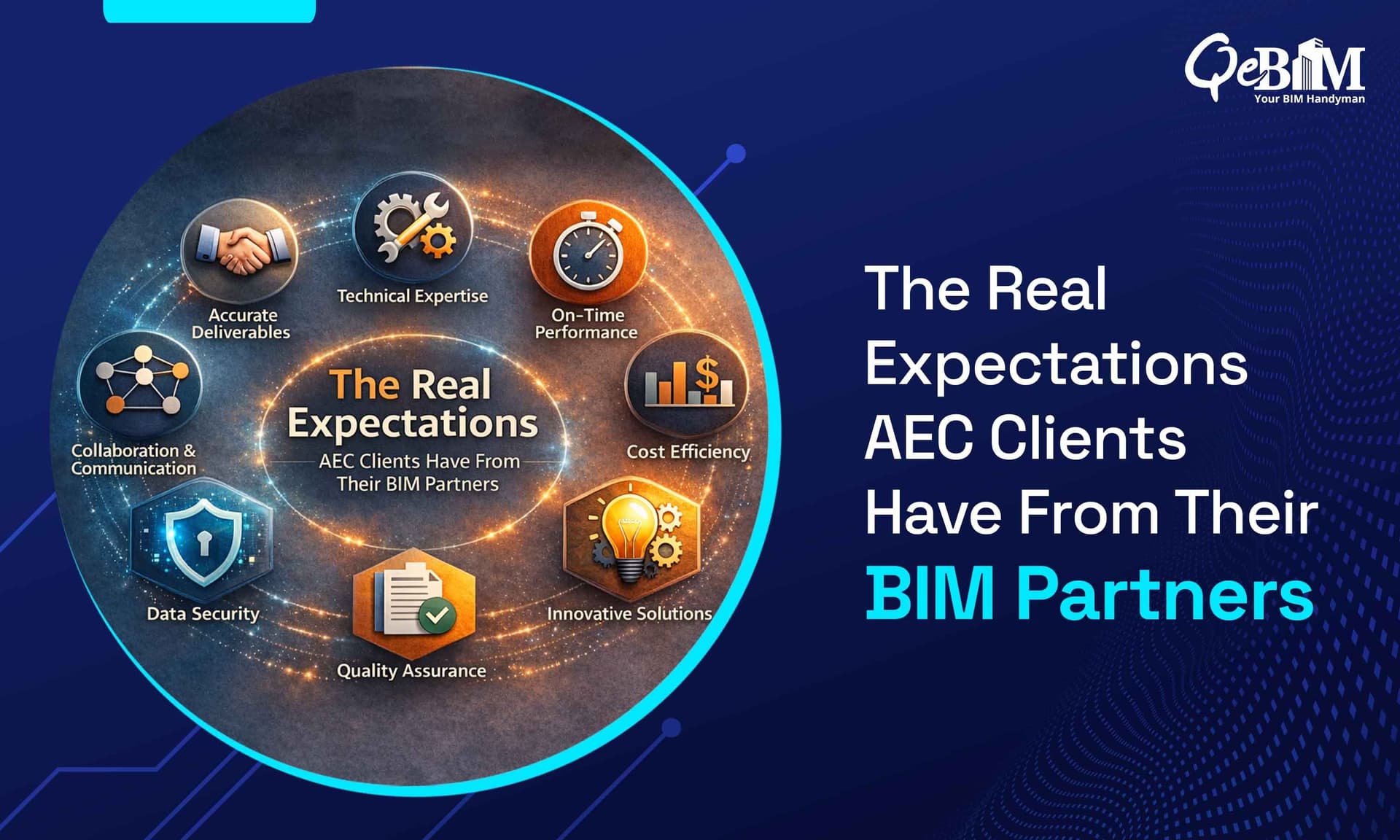
The Real Expectations AEC Clients Have From Their BIM Partners
In today’s fast-evolving construction ecosystem, BIM is no longer just a technical support function — it is a strategic enabler. As projects grows more complex and margins tightens, the AEC firms are moving away from the transactional outsourcing and seeking long-term BIM partnerships instead.
But what exactly do the AEC clients expect from a long-term BIM partner?
The answer goes far beyond modeling.
1. Strategic Expertise — More Than Just Software Proficiency
AEC clients expect their BIM partner to understand the why of the project — and not just the how.
A true BIM Services Provider should:
Align with the project goals and delivery milestones
Understand local codes and compliance standards
Integrate with the client’s internal workflows
Proactively flag risks before they escalate
Clients no longer want someone who simply follows instructions. They want a partner who can anticipate coordination issues, suggest process improvements and contribute to smarter project execution.
2. Consistency Across Projects
Long-term relationships are built on predictability and reliability.
AEC firms expect:
Standardized modeling practices
Clear documentation protocols
Defined quality control systems
Version management discipline
When BIM standards vary from project to project, coordination breaks down. A dependable partner ensures the uniformity in LOD definitions, naming conventions, clash detection workflows and data structuring.
Consistency reduces reworks. And in construction, reduced rework directly impacts the profitability.
3. Deep Coordination Expertise
Clashes don’t just happen because of design errors — they often result from communication gaps between disciplines.
Clients expect long-term BIM partners to:
Facilitate multi-disciplinary coordination
Run structured clash detection cycles
Provide actionable clash reports
Participate in coordination meetings
Beyond running software, they expect analytical thinking. A strong partner interprets clashes, prioritizes critical issues and recommends resolution paths instead of simply generating reports.
4. Scalability and Flexibility
Project volumes fluctuate. Deadlines shift. Scope expands.
AEC clients value partners who can:
Scale teams quickly when the deadlines tighten
Allocate specialists for MEP, structural or architectural workflows
Support different project types — commercial, healthcare, residential, infrastructure
A reliable partner offers flexibility without getting down in terms of the quality. This is particularly important for firms expanding geographically or managing multiple projects simultaneously.
5. Strong Communication & Transparency
Technical capability alone doesn’t sustain the long-term collaboration.
Clients expect:
Clear turnaround times
Regular progress updates
Transparent pricing structures
Direct access to project leads
Time zone differences and offshore collaboration are common today. What differentiates a dependable partner is responsiveness and clarity in communication.
Transparent reporting builds trust — and trust sustains the partnerships.
6. Ownership Mindset
AEC firms increasingly prefers the partners who act like an extension of their internal team.
That means:
Taking accountability for deliverables
Maintaining data security and confidentiality
Following structured review and approval workflows
Proactively suggesting efficiency improvements
A vendor follows instructions.
A partner drives accountability.
There’s a significant difference.
7. Technology Adaptability
The BIM ecosystem is evolving rapidly — from digital twins to 4D/5D simulation and AI-enabled coordination.
Clients expect long-term partners to:
Stay updated with the all the BIM tools along with the workflows
Adapt to new client standards and platforms
Integrate automation where possible
Support cloud-based collaboration environments
However, technology adoption must support process — not complicate it. Smart implementation matters more than the tool quantity.
8. Data Accuracy & Model Intelligence
Modern BIM is not just the geometry — it’s structured data.
A professional team delivering BIM Modeling Services is expected to:
Embed accurate parametric data
Maintain proper element classification
Ensure model audit compliance
Deliver models ready for downstream use (quantity take-offs, facility management, cost estimation)
AEC firms increasingly rely on the BIM models beyond the design — into construction and operations. Accuracy and intelligence directly influence the lifecycle value.
9. Long-Term Cost Efficiency
Clients are not necessarily looking for the lowest quote. They are looking for long-term value.
A strong BIM partner helps to:
Reduce RFIs
Minimize reworks
Improve coordination efficiency
Shorten project timelines
The financial benefits of effective BIM execution frequently exceed the cost of the service itself.
Long-term partners understand this and focus on measurable outcomes.
10. Cultural Alignment & Reliability
Finally, long-term collaboration depends on alignment in work culture, ethics and expectations.
Clients value partners who:
Respects deadlines
Follows structured escalation protocols
Maintains documentation discipline
Demonstrate professionalism at every interaction
Technical capability gets you hired.
Reliability keeps you retained.
Final Thoughts
The AEC industry is shifting from vendor-based outsourcing to partnership-driven collaboration. Firms no longer want short-term model production support. They want strategic BIM allies who elevates project efficiency, mitigate risks and supports sustainable growth. The question is no longer:
“Can you create a model?”
It is:
“Can you consistently add value across multiple projects, teams and years?”
Long-term BIM partnerships are built on process maturity, accountability, communication and continuous improvement.
And those are expectations that go far beyond modeling.