

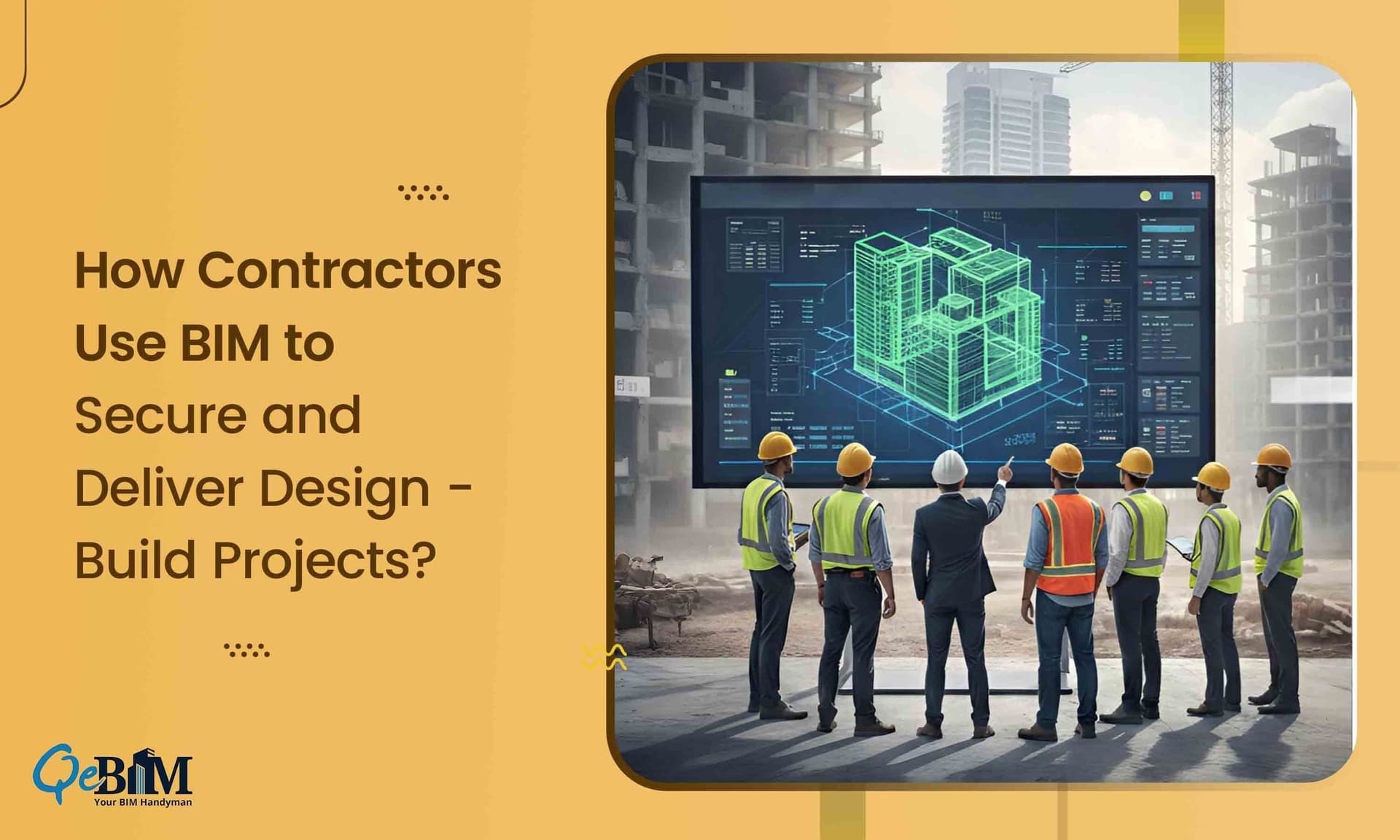
How Contractors Use BIM to Secure and Deliver Design-Build Projects?
Design-build is no longer just an alternative delivery method—it’s becoming the preferred model across the commercial, healthcare, infrastructural and industrial projects. Owners want speed. They want cost certainty. And most importantly, they want accountability under one roof.
For contractors, this means one thing: you are no longer just builders—you are solution providers from day one.
And that’s where BIM becomes your biggest competitive advantage.
The Design-Build Shift: Why Contractors Must Think Like Designers
In traditional design-bid-build, contractors enters after most of the design decisions are made. In design-build, contractors are involved early—often during the conceptual planning.
This changes everything.
You’re expected to:
Validate the design feasibility
Offer the cost intelligence early
Identify risks before the documentation is complete
Optimize construction sequencing
Reduce reworks and site conflicts
Without a structured digital workflow, this becomes risky.
With BIM, it becomes strategic.
1. Stronger Proposals Backed by Visual Clarity
When bidding for design-build projects, owners are not just comparing price—they are comparing the capability.
Contractors who present:
3D coordination models
Construction simulations
Phasing visuals
Clash detection reports
Quantity take-offs from models
instantly stands apart from the competitors relying on the 2D drawings alone.
A coordinated BIM model shows the owners that:
You understand complexity.
You can foresee issues.
You are proactive, not reactive.
This builds trust even before the project begins.
2. Early Risk Identification = Higher Owner Confidence
Design-build contracts shifts the design liability and coordination responsibility to the contractor-led team.
According to multiple industry studies, up to 30% of construction reworks is caused by the design coordination errors. BIM-based clash detection can reduce the coordination conflicts by over 70% before reaching the site.
When contractors demonstrate:
Early MEP coordination
Structural-architectural integration
Constructability reviews through models
they reduce the uncertainty for owners to a greater extent.
And owners rewards certainty.
3. Better Cost Control from Day One
In design-build, cost transparency is critical.
With BIM-enabled quantity extraction and model-based estimation:
Quantities are more accurate.
Scope gaps are minimized.
Variations are reduced.
Value engineering becomes data-driven.
Instead of reacting to the change orders, contractors can proactively optimize the materials and systems during the design.
This elevates the contractor from a mere executor to a strategic project partner.
4. Faster Delivery Through 4D Planning
Time is one of the biggest selection criteria in design-build.
4D BIM (schedule-linked models) allows the contractors to:
Simulate the construction sequences
Identify the logistical conflicts
Optimize the site workflows
Communicate the phasing clearly to the stakeholders
When owners see how the building will be constructed—not just what it will look like—it builds confidence in delivery capability.
Faster, clearer execution plans often become a deciding factor in awarding contracts.
5. Improved Collaboration Across Disciplines
Design-build thrives on integration.
BIM brings architects, engineers and contractors together on a single coordinated digital framework. Instead of fragmented coordination, teams operate with:
Real-time model updates
Centralized documentation
Transparent change tracking
Structured revision workflows
This collaborative ecosystem reduces the disputes and improves the decision-making speed.
For contractors, this means fewer surprises and stronger project control.
6. Competitive Differentiation in Interviews
During design-build interviews, contractors are often asked:
How will you manage coordination?
How will you reduce the change orders?
How will you control the cost and schedule risks?
Contractors supported by a specialized BIM Company can demonstrate:
Detailed coordination workflows
Proven clash resolution metrics
Model-based reporting dashboards
LOD development strategies
This transforms the interviews from theoretical discussions into evidence-backed presentations.
That difference often wins the projects.
7. Strengthening Long-Term Client Relationships
Owners increasingly prefers the contractors who bring the digital maturity to the table.
By offering the structured BIM Services for GC, contractors can:
Provide as-built digital twins
Support the facility management handovers
Delivers the accurate asset data
Improves the lifecycle performances
This extends the value beyond the construction and positions the contractor for repeat businesses.
The Bottom Line: BIM Is No Longer Optional in Design-Build
Design-build projects demands:
Early integration
Predictable outcomes
Cost clarity
Reduced risk
Faster delivery
BIM empowers the contractors to meet all of these expectations—before the construction even begins.
In today’s competitive market, winning the design-build projects is not just about offering the lowest bid. It’s about demonstrating the highest capability.
Contractors who embrace BIM don’t just build projects.
They build confidence.