

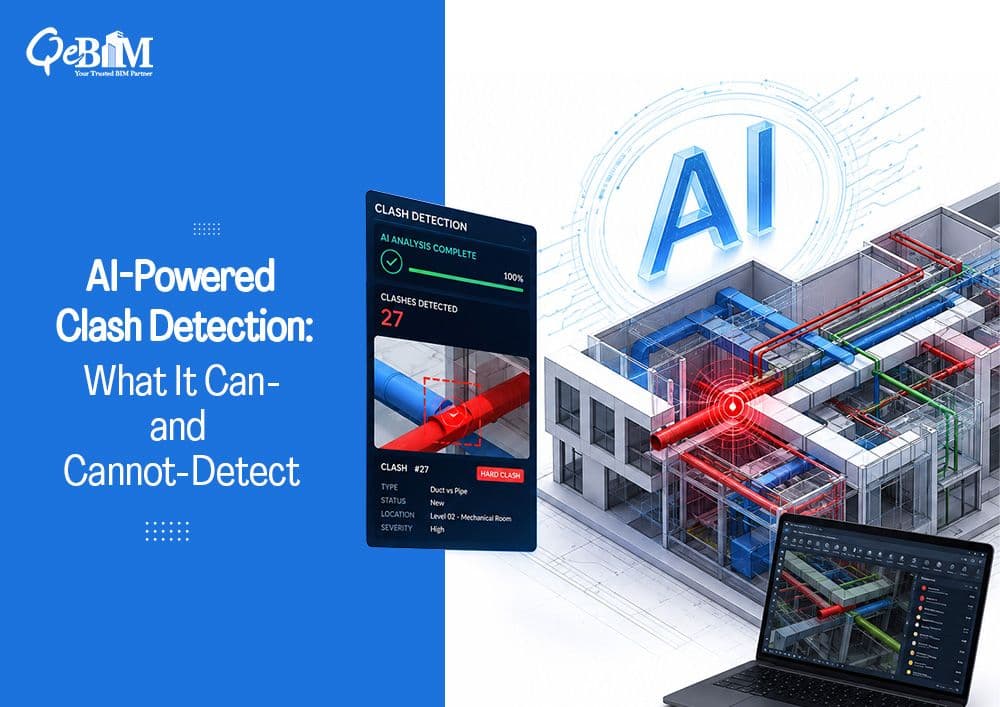
AI-Powered Clash Detection: What It Can—and Cannot—Detect
Clash detection has long been one of the most valuable applications of BIM coordination. Traditionally, coordination teams have relied more on rule-based software to identify geometric conflicts between architectural, structural and MEP models. Today, artificial intelligence and machine learning are beginning to change that workflow—not necessarily by replacing the conventional clash detection, but by helping the teams to understand which detected clashes actually matters.
This raises an important question: how much can you trust AI-assisted clash detection?
The short answer is: trust it as a decision-support system and not as the ultimate decision-maker.
From Finding Clashes to Understanding Clashes
Traditional clash detection primarily answers one question:
“Do these two elements conflict?”
For example, a mechanical duct may intersect a structural beam, or a sprinkler pipe may occupy the same space as a lighting fixture. Rule-based engines can identify these geometric relationships quickly across the large federated models.
However, not every detected intersection represents a construction problem.
A pipe passing through a designated opening may technically register as a clash but could be intentional. Similarly, insulation may intersect another system within an accepted tolerance, while multiple services may occupy a congested ceiling zone without physically intersecting.
buildingSMART describes clash detection as an automated, rule-based process involving models, specified rules, and tolerances.
AI adds another layer: interpreting the significance of those clashes.
What AI Can Do Better?
AI-assisted systems can analyze patterns in previous coordination decisions and use model metadata, element relationships, spatial context and historical issue data to classify detected conflicts.
Instead of presenting a coordinator with hundreds or thousands of raw results, an AI system could potentially categorize them as:
High-priority construction conflicts
Likely false positives
Intentional intersections
Design-rule violations
Clearance or accessibility concerns
Clashes requiring human review
Recent research published in Automation in Construction demonstrated the use of machine learning to automate the filtering and classification of true and false clashes, with the objective of replicating aspects of BIM coordinator decision-making.
This is an important shift.
The real productivity gain may not come from detecting more clashes, but from reducing the number of clashes humans need to investigate manually.
Why AI Cannot Be Trusted Blindly?
AI is only as reliable as the information and patterns it learns from.
Consider a project where the BIM models contains inconsistent classifications, incomplete parameters, incorrect coordinates or outdated design information. An AI system may confidently analyze that data—but its conclusions can still be wrong.
Model quality is therefore fundamental.
Even conventional clash results can vary depending on tolerance and model versions. Autodesk notes, for example, that different clash tolerances can produce different results, with smaller tolerances potentially generating additional clashes that are not meaningful for coordination.
AI does not eliminate this underlying problem.
It can also struggle with the design intent. A human coordinator may understand that a particular pipe penetration has been deliberately designed, that a clearance is acceptable under project requirements, or that moving one component would create a larger downstream problem.
That contextual knowledge may not exist in the training data.
The Biggest Risk: False Confidence
The most dangerous AI failure is not necessarily missing an obvious clash.
It is creating false confidence.
If a coordination team assumes that an AI system has correctly classified every clash, a low-priority issue could be ignored when it actually represents a significant construction risk.
This is particularly important for complex projects involving hospitals, airports, data centers, industrial facilities and infrastructures, where spatial coordination can involve thousands of components and highly specific design requirements.
Research into AI-based BIM clash management continues to identify false-positive filtering and prioritization as major challenges. Recent studies emphasizes that the detection alone does not solve the coordination; relevant issues still require interpretation and resolution by experienced professionals.
AI + Human Expertise Is the Stronger Model
The practical future is therefore unlikely to be AI versus BIM coordinator.
It is more likely to be AI + BIM coordinator.
A robust workflow could look like this:
1. Model validation
Before clash detection begins, check coordinates, model versions, classifications, geometry and required information.
2. Automated detection
Run rule-based clash tests using appropriate tolerances and discipline combinations.
3. AI-assisted classification
Use machine learning to group, prioritize and identify potentially irrelevant or repetitive clashes.
4. Human review
A BIM coordinator evaluates high-impact and uncertain cases using the project standards, design intent, constructability and stakeholder requirements.
5. Issue management
Document approved issues, assign responsibility, track status and communicates the resolutions through a structured workflow.
OpenBIM standards can support this process. buildingSMART's BIM Collaboration Format (BCF), for example, enables model-based issues to be exchanged between BIM applications while referencing specific model elements and viewpoints.
What Should Clients Expect from AI-Assisted Clash Detection?
Clients should not measure an AI-enabled coordination workflow simply by asking:
“How many clashes did the software find?”
Better questions are:
How many detected clashes were genuinely actionable?
How effectively were false positives filtered?
Can the system explain why an issue was prioritized?
Are model versions and tolerances controlled?
Is human validation built into the workflow?
Can issues be tracked through resolution?
Are decisions documented for future coordination cycles?
This changes the definition of accuracy.
A highly accurate clash detection process is not necessarily the one producing the largest number of clash reports. It is the one helping the project team identify the meaningful risks early and resolve them efficiently.
The Future of Clash Detection
AI will likely make coordination increasingly predictive rather than reactive.
Instead of waiting for two elements to conflict, future systems may identify patterns suggesting that a proposed design is likely to create coordination problems later. Research is already exploring the predictive approaches that uses machine learning to forecast potential component conflicts before they occur.
But this evolution will not make human coordination obsolete.
AI can recognize patterns. BIM coordinators understand consequences.
That distinction matters.
For organizations investing in the Clash Detection Services, the strongest approach is therefore to combine automated analysis with disciplined BIM workflows, validated models, clearly defined coordination rules, and experienced human review. Likewise, accurate Revit Modeling services remains essential because AI cannot compensate for fundamentally unreliable model geometry or information.
The future of clash detection isn't about trusting AI completely. It's about knowing where AI is reliable—and where human judgment must remain in control.