

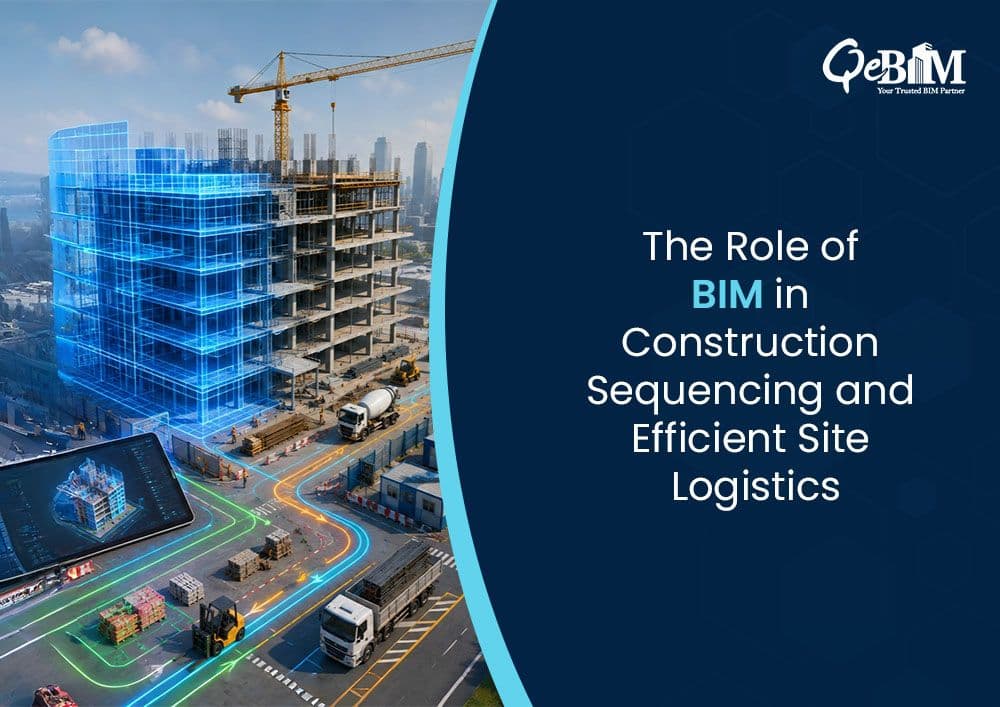
The Role of BIM in Construction Sequencing and Efficient Site Logistics
Introduction
Construction projects are becoming increasingly complex, involving multiple stakeholders, overlapping activities and strict schedules. Traditional planning methods often rely on the static schedules and 2D drawings, which can make it difficult to visualize the construction progress, anticipate conflicts and optimize the site operations. BIM has transformed the project planning by introducing a data-driven and visual approach to construction sequencing and logistics management.
By integrating the time and construction activities with the digital models, BIM enables the project teams to simulate the entire construction process before the work begins. This capability improves the coordination, minimizes disruptions and enhances the overall project efficiency thus making BIM an essential tool for modern construction management.
Understanding Construction Sequencing in BIM
Construction sequencing refers to the planned order in which building elements and activities are executed. Proper sequencing is critical to maintaining the schedule integrity, resource allocation and safety standards.
With 4D BIM Services, the 3D model is linked with the project schedules to develop a time-linked simulation of the construction process. This allows the project stakeholders to visualize how the structure will be built over the time and identify potential issues before they occur.
4D simulations help teams:
Visualize the construction progress at every stage.
Detect sequencing conflicts between the trades.
Validate construction methodologies.
Improve communication among the contractors and stakeholders.
Optimize resource deployment and equipment usage.
Unlike traditional Gantt charts, BIM-based sequencing provides a dynamic and visual representation that improves the decision-making throughout the project lifecycle.
Role of BIM in Site Logistics Planning
Site logistics planning involves organizing the movement of materials, equipment, labor and temporary facilities within a construction site. Poor logistics planning often leads to the congestion, delays, safety hazards and productivity losses.
BIM enables teams to develop virtual site layouts and evaluate logistics scenarios before the physical work begins.
Project managers can assess:
Material storage locations.
Crane positioning and lifting paths.
Temporary roads and access routes.
Equipment movement and staging areas.
Worker circulation and safety zones.
Temporary structures and site offices.
By simulating site conditions, BIM helps create efficient workflows and minimize operational disruptions.
Visualizing Construction Activities
The visible advantages of BIM-based sequencing is its ability to visualize complex construction activities.
Project teams can simulate:
Foundation and Structural Phases
BIM allows the engineers and contractors to analyze the excavation processes, reinforcement installation, concrete pours and structural assembly in chronological order.
MEP Installation
Mechanical, electrical and plumbing systems involves extensive coordination. BIM helps to schedule the MEP activities alongside the structural work thus reducing the clashes and avoiding reworks.
Prefabrication and Modular Construction
Offsite manufacturing requires precise timing between the fabrication and onsite assembly. BIM simulations ensures that the components arrive at the correct time and are installed according to schedule.
Interior Fit-Out Activities
Interior construction phases can be sequenced effectively to avoid the interference among the trades and improve the workforce productivity.
Clash Detection Beyond Geometry
Traditional clash detection focuses on identifying physical conflicts between the building systems. However, BIM also enables the "time clashes" or sequencing conflicts.
Examples include:
Multiple trades scheduled in the same workspace simultaneously.
Equipment access blocked by unfinished structural elements.
Material deliveries arriving before the storage areas are available.
Crane operations conflicting with the ongoing construction activities.
Early identification of these issues reduces the delays and improves the construction flow.
Enhancing Site Safety Through BIM
Safety planning is closely tied to sequencing and logistics. BIM models allows the teams to visualize the potential hazards and implement the preventive measures before the construction begins.
Applications includes:
Defining exclusion zones around heavy equipment.
Planning safe access routes for workers.
Simulating crane operations and lifting activities.
Identifying fall protection requirements.
Coordinating emergency evacuation paths.
Virtual safety planning contributes to reduced incidents and better compliance with the safety rules.
Resource Optimization and Productivity
Construction efficiency depends heavily on the resource management. BIM enables the project managers to optimize:
Labor Allocation
Visual schedules helps to distribute the crews efficiently and prevents overcrowding at work zones.
Material Management
Sequenced deliveries reduces the storage requirements and minimizes the material handling.
Equipment Utilization
Heavy machinery and cranes can be scheduled more effectively thus reducing the idle time and improving the productivity.
Space Management
Temporary facilities, storage areas and access roads can be planned to maximize available site space.
These optimizations contributes to lower costs and smoother project execution.
Supporting Lean Construction Principles
Lean construction focuses on eliminating wastes and maximizing value. BIM supports lean methodologies by improving the process predictability and reducing inefficiencies.
Key benefits includes:
Reduced waiting time between activities.
Lower material waste.
Minimized reworks and schedule disruptions.
Better collaboration among disciplines.
Improved workflow continuity.
By providing a digital representation of the construction process, BIM helps to create more reliable and efficient project delivery systems.
Integration with Emerging Technologies
Modern BIM workflows are integrated with latest technologies such as:
Artificial Intelligence
AI can analyze schedules, predict delays and optimize sequencing strategies based on historical project data.
Digital Twins
Real-time site data can be connected with the BIM models to monitor construction progress and compare planned versus actual performance.
Drones and Reality Capture
Drone imagery and laser scanning provides site updates that can be incorporated into BIM models for progress tracking and validation.
IoT Sensors
Connected devices enables the monitoring of equipment, materials and environmental conditions thus improving the logistics and safety management.
These technologies further enhances the value of BIM-driven construction planning.
Improving Collaboration Among Stakeholders
Construction sequencing and site logistics involves architects, engineers, contractors, subcontractors and owners. BIM creates a common digital environment where all participants can review and coordinate project activities.
A reliable BIM Services Provider enables the project teams to share accurate information, visualize workflows and make informed decisions throughout the construction. Enhanced collaboration reduces the misunderstandings and supports timely project execution.
Conclusion
Construction sequencing and site logistics are fundamental to successful project delivery. Traditional planning methods often lacks the visualization and coordination capabilities required to manage today's complex projects. BIM introduces a proactive approach by combining the design data with schedule and site information, enabling the teams to simulate construction activities, optimize resources, improves safety and reduce delays.
As digital construction continues to evolve, BIM-driven sequencing and logistics planning will play an increasingly important role in delivering projects with greater efficiency, predictability and collaboration. Organizations that leverages these capabilities are better positioned to achieve higher productivity, minimizes risks and ensures successful project outcomes.