

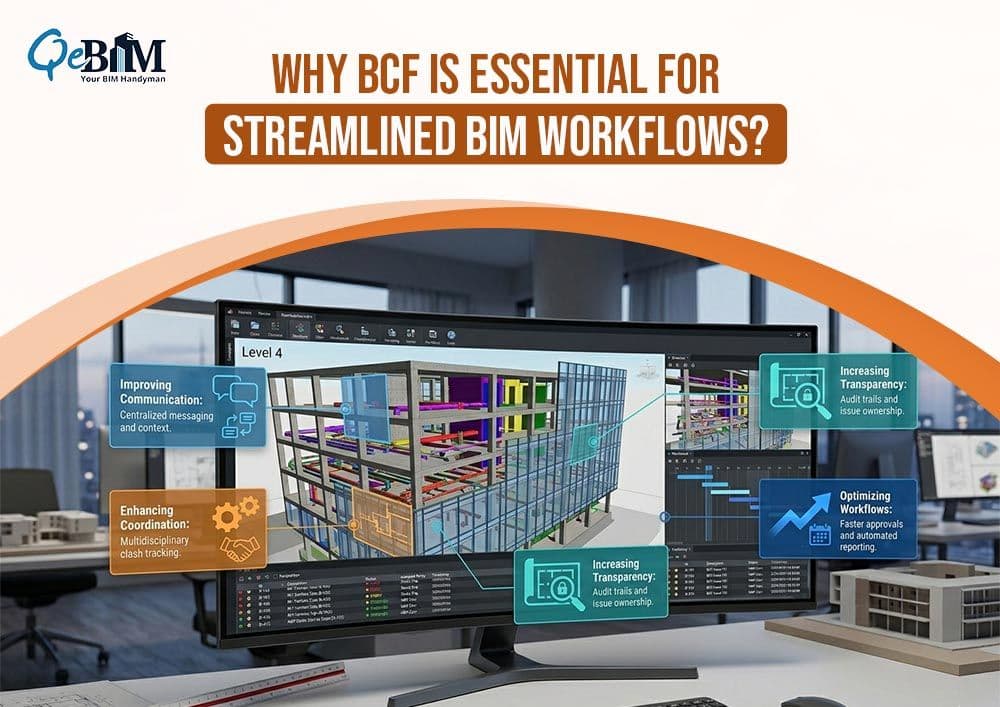
Why BCF is Essential for Streamlined BIM Workflows?
Considering the latest AEC scenario, coordination is no longer just about identifying the issues—it’s about resolving them efficiently and preventing them from recurring. While BIM has already transformed how the teams design and collaborate, the real challenge lies in managing the communication across multiple stakeholders, platforms and timelines. This is where the BIM Collaboration Format (BCF) emerges as a powerful enabler thus turning the fragmented issue tracking into structured, predictable outcomes.
What Exactly is BCF?
BCF acronyms for BIM Collaboration Format is an open standard that enables clear and efficient communication among project stakeholders. Instead of sharing heavy model files, BCF allows the teams to exchange the issue-related information—such as comments, viewpoints, screenshots and metadata—without altering the original model.
In simple terms, BCF acts as a communication layer that sits on top of the BIM workflows thus ensuring that every issue is clearly documented, assigned and tracked until resolution.
The Problem with Traditional Issue Tracking
Before BCF, issue tracking in BIM projects often relied on the emails, spreadsheets or disconnected tools. This created several inefficiencies:
Lack of context around issues
Miscommunication between the teams
Difficulty in tracking the resolution status
Redundant back-and-forth exchanges
Increased risk of errors during the implementation
As projects grew more complex, these gaps led to delays, cost overruns and coordination failures.
How BCF Changes the Game?
1. Context-Driven Communication
BCF files include visual viewpoints linked directly to the model. This ensures that every stakeholder understands the exact location and nature of the issue without any ambiguity.
2. Platform-Agnostic Collaboration
BCF is not tied to a single software platform. Whether teams are using different BIM tools, they can still collaborate effectively without any compatibility issues.
3. Structured Issue Management
Each issue in BCF comes with attributes such as status, priority, author and due date. This transforms the informal communication into a structured workflow.
4. Reduced File Size and Faster Communication
Unlike full BIM models, BCF files are lightweight thus enabling quick sharing and faster decision-making.
From Issue Tracking to Predictable Outcomes
The real value of BCF lies in its ability to shift the teams from addressing issues as they arise to managing projects with foresight and control.
Improved Accountability
With clearly assigned responsibilities, the teams know who is responsible for resolving each issue thus reducing the delays and confusion.
Enhanced Transparency
All stakeholders have visibility into the issue lifecycle—from identification to closure thereby ensuring alignment at every stage.
Faster Decision-Making
By providing all necessary context in one place, BCF minimizes the need for lengthy discussions and clarifications.
Reduced Rework
Clear communication and accurate issue tracking significantly lowers the chances of errors being carried forward into later stages.
Integration with BIM Workflows
BCF integrates seamlessly with the leading BIM tools, making it a natural extension of existing workflows. For firms offering Revit BIM Services, BCF enhances the coordination by enabling the real-time issue tracking directly within the modeling environment. This ensures that the design updates are aligned with the resolved issues thus maintaining the model accuracy throughout the project lifecycle.
Similarly, teams delivering the Architectural Modeling Services benefit from BCF by streamlining the communication between the architects, engineers and consultants. This leads to better design coordination and fewer revisions.
Best Practices for Using BCF Effectively
To maximize the benefits of BCF, teams should adopt a structured approach:
Define clear naming conventions for issues
Assign priorities and deadlines consistently
Maintain regular coordination reviews
Ensure proper documentation of issue resolutions
Integrate BCF into standard BIM execution plans
These practices helps to create a disciplined workflow that supports the predictable outcomes.
The Future of BIM Collaboration
As digital construction continues to evolve, the focus is shifting towards the data-driven decision-making and integrated project delivery. BCF plays a critical role in this transformation by enabling smarter collaboration and more efficient issue resolution.
With increasing adoption across the AEC industry, BCF is no longer just a coordination tool—it is becoming a standard for communication in BIM projects.
Conclusion
BCF bridges the gap between the issue identification and resolution by providing a structured, transparent and efficient communication framework. It empowers the teams to move beyond the reactive coordination and towards the predictable, outcome-driven project delivery.
In a world where project timelines are tight and margins are critical, leveraging BCF is not just an advantage—it’s a necessity.